Sundar Pichai’s Warning on an AI Bubble: What Investors, VCs and Corporate Adopters Need to Do Now

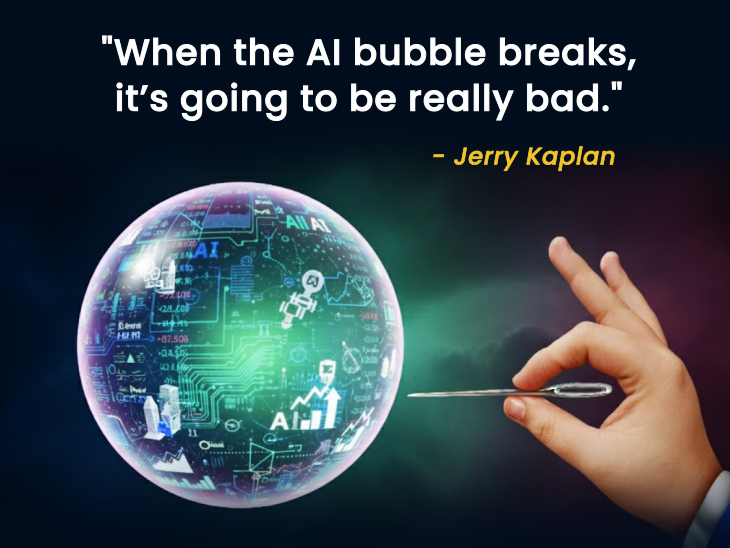
In a BBC interview published Nov. 18, 2025, Alphabet/Google CEO Sundar Pichai described the current phase of AI investment as an “extraordinary moment” but acknowledged “elements of irrationality” and warned that if the AI boom collapsed “no company would be immune, including us.” Reuters and several outlets covered the interview and highlighted that Alphabet continues to place heavy bets on AI infrastructure and research even as Pichai flagged risks.
Pichai’s warning matters because it comes from the leader of one of the largest beneficiaries of the AI cycle — a firm that has gained materially in market cap this year on AI expectations. When the chief executive who is investing the most publicly flags “irrationality,” it’s a signal to markets that tail risks exist even for dominant firms.
What this means for public-market investors
1. Don’t conflate momentum with durable economics. Many AI winners have seen sky-high multiples based on growth expectations. A correction could compress multiples widely — including among profitable platforms. Pichai’s comment is a reminder to focus on cash flow durability, not just headline AI exposure.
2. Hedge concentration risk (hardware & platform exposure). GPU/chip leaders (Nvidia, etc.) and cloud/data-center suppliers are central nodes of the AI ecosystem. They can be winners in multiple cycles — but also face sharp corrections in demand and inventory dynamics if model training slows. Tactical hedges and option protection for concentrated positions are prudent.
3. Reassess valuation sensitivity to growth assumptions. Run scenario analyses that stress revenue growth and margin expansion assumptions (base, downside, tail-risk). Price-in liquidity and exit risk for highly speculative names.
4. Watch capex cycles and energy costs. Pichai warned the power and compute demands could affect net-zero targets and operational costs, which in turn affect margins and cash flow. That’s a corporate-level risk you should model.
What this means for venture capitalists
1. Expect longer exits and tougher IPO windows. If market sentiment cools, IPO and M&A markets narrow. VCs should preserve dry powder for follow-ons and prepare portfolio companies for extended private life.
2. Prioritize capital efficiency and unit economics. Seed and Series A rounds should favor companies with fast paths to measurable ROI or proprietary defensibility (data, regulatory moats, specialisation). Avoid deploying large rounds into “vision-only” plays without clear monetization.
3. Structure round economics for downside protection. Consider tranche-based funding, stronger protective provisions, and convertible instruments that cushion valuations through cycles.
4. Be selective on infrastructure bets. Heavy capex plays (data-center scale, custom silicon fabs) are higher-risk in a correction — they require long time horizons and deep pockets.

What this means for the biggest AI-focused companies (Alphabet, Microsoft, Nvidia, OpenAI, etc.)
• Scale helps but doesn’t immunize. Pichai’s admission — that even Google wouldn’t be immune — is candid: large balance sheets and diversified revenue help, but valuation multiples and cyclical capex still transmit shock to share prices and investment plans.
• Capex & energy trade-offs. Firms expanding model training and data-centre capacity may see near-term margin pressure and delayed sustainability targets as they prioritize compute expansion. Investors should watch gross margins, capex cadence, and energy disclosures.
• Regulation & liability risk grows with scale. As AI products scale, legal and compliance costs — and potential fines — become bigger lines on the P&L.
What it means for companies adopting AI (non-tech corporates)
1. Measure ROI at the initiative level. Treat AI projects like product investments: run pilot → measure throughput/time saved → estimate incremental revenue or cost avoided → only scale if ROI meets thresholds.
2. Beware of hype-driven vendors. An AI vendor that markets transformative gains with no proof points should be vetted for reproducible results and SLA/escrow clauses on models and data.3.Operationalize model risk. Pichai highlighted that models are “prone to some errors” — enterprises must have human-in-the-loop systems, audit trails, and monitoring for drift and bias.
3. Plan for variable total cost of ownership (TCO). Training and serving costs, data storage, and compliance can outstrip initial vendor quotes — budget for scale.
Practical checklist for financial readers (actionable)
• Re-run valuation sensitivity on all AI-exposed holdings (3 downside scenarios).
• For new investments, require proof-of-outcome (pilot metrics) or price-adjusted terms.
• VCs: increase follow-on reserves by 15–30% and add bridge financing plans.
• Corporate CFOs: require ROI gating and include compute/energy scenarios in budgets.
• All: monitor public statements and capex commitments from Big Tech for leading indicators.
Bottom line
Sundar Pichai’s warning is not an instruction to flee AI exposure — it’s a call for discipline. AI is likely to be transformative over the long run, but history shows “irrational exuberance” can produce sharp short- to medium-term corrections. Financial professionals should treat the current phase as one that requires active risk management: prefer high-quality cash flows, preserve optionality, and stress-test portfolios and business plans against a realistic downside.
You may Also Like

Best Way to Use Amex Membership Rewards Points in 2026: Maximize Value with Marriott, Airlines & Smart Transfers

SBI Funds Management IPO 2026: Price Band, GMP, Dates, Issue Size & Should You Apply?